Abe Shinzo, the destroyer of
democracy
Immediately after the assassination of former prime
minister Abe Shinzo on 8 July, leaders of all the political parties in Japan issued
statements declaring that they would never tolerate such a dreadful act of
violence that destroys democracy. This sounds like a perfectly natural response
to the shooting, and no one should have any objection to it.
However, it is not only visible physical violence that destroys
democracy. Johan Galtung, a Norwegian peace studies scholar, coined the term
“structural violence” to describe a different type of violence in which the
actors of the violent act are invisible. Structural violence means poverty,
hunger, oppression, discrimination, obscurantist policies and the like. In
retrospect, Abe Shinzo was the one who took full advantage of structural
violence to destroy democracy by constantly spewing lies and deception, like a
heavy smoker who spreads filthy smoke everywhere.
“Abenomics” – which Abe introduced as an “economic revitalisation policy”
– has brought about a sharp rise in prices and huge wage disparities, while simultaneously
increasing the defence budget every year. As a result, the lives of many
ordinary citizens are heavily burdened, especially single-mother families, the elderly,
and the homeless. The impoverishment of these people is increasing daily.
Rather than revitalising their lives, Abenomics has forced many citizens to
struggle to find ways to survive.
On Moritomo School, the Kake veterinary faculty, and annual cherry blossom
garden parties, Abe squandered taxpayers’ money as though it literally grew on
trees. When the truth was about to be exposed, he made bureaucrats under his
control cover up, falsify, and destroy the evidence to get away with his
crimes. In the Moritomo School corruption case for which he and his wife were largely
responsible, he drove one of the Ministry of Finance officials to commit
suicide, ultimately forcing him to take the final responsibility. If this is
not violence, then what is?
Deliberately misusing and abusing Galtung’s concept of “positive peace”,
Abe enacted one unconstitutional law after another. The law authorising the
right of collective self-defence, the special secret protection law, and the
conspiracy law all contain examples of his typically delusional claims.
In his bid to host the 2020 Olympic Games in Tokyo, Abe tried to cover
up the effects of the Fukushima nuclear power accident by stating: “For those
of you who are worried about Fukushima, let me assure you, the situation is
under control. Tokyo has not been and will not be adversely affected in any way.”
In so doing, he shamelessly lied to the world. Vast quantities of radioactive
water continue to flow into the plant; the situation there is completely out of
control.
In diplomacy, his deep sense of racial discrimination was blatantly
reflected on many issues. For example, he tried to end the Korean pursuit of Japan’s
war responsibility for the Japanese military sexual slavery (so-called “comfort
women”) with a Japan–Korea agreement which he termed a “final and irreversible
solution”. In fact, this characteristically deceptive phrase meant: “We will
pay you a billion yen so you will shut up about the issue from now on.” In this
way, one billion yen was used to buy the memory of the historical fact of
Japanese military sexual slavery, and to erase the memory of this war crime from
history.
Nonetheless, in response to strong criticism from the US media of his dishonest
approach to the comfort woman issue, Abe expressed his apologies to President
George Bush at Camp David in March 2007. The president accepted his apology, while both men ignored the actual
victims of the Japanese military sex enslavement. Abe never expressed an
apology directly to any former comfort woman prior to or following this meeting
with Bush. Similarly, on the issue of US military bases in Okinawa and arms
purchases from the US, Abe flirted Presidents Obama and Trump as if he were their pet
dog wagging his tail, and he made huge US arms purchases.
Let me reiterate that Abe was the one who destroyed Japan’s originally
fragile democracy by taking full advantage of structural violence. Furthermore,
Trump and Abe are the two who will go down in history as the heads of state who
told the biggest lie of all.
State funerals: acts of subversion
of democracy by state powers
The Kishida administration and the Liberal Democratic
Party (LDP) are eager to politically exploit the death of a
democracy-destroying politician – this time, in the form of a state funeral.
Strangely enough, Abe’s death has exposed a long-standing cosy
relationship between a pseudo-religious organisation called the Unification
Church and many LDP members who accept large donations (bribes) and other forms
of political support from this church. Abe’s assassin was one of the victims of
this church’s dubious activities. Donning the false cloak of religion, the
Unification Church takes advantage of ordinary people’s mental vulnerability to
extort money and at the same time strongly advocate anti-communism.
In an effort to cover up LDP’s corrupt relationship with the Unification
Church, the government is now trying to enshrine Abe as a “great defender of
democracy,” wrapping his death in a second layer of lies to cover the many deceits
of his lifetime. Accordingly, a solemn state funeral is now being planned as an
official government event with many distinguished foreign leaders being invited.
The true aim of this state funeral is to guard and preserve the political power
of the ruling LDP by paralysing the public’s rational thinking. Politicians who
have been victims of “vile violence” are the most convenient figures to be used
for such state mythologising.
The same logic used to enshrine Class A war criminals is at work here. Once
enshrined, war criminals such as Tojo Hideki must be remembered and revered as
noble and holy human beings, and their personal histories must not be
questioned. At the same time, the history of Japanese imperialism which produced
such soldiers must not be questioned. When the state power mourns a particular
person by holding a national funeral, it legitimises its own power by
enshrining and mythologising the person. State funerals are held for the
purpose of bringing political benefits to a particular political party or
politician who is in control of state power; there is no such thing as a “non-political”
or “politically neutral” state funeral. A state funeral is not only a clear
violation of the Constitution of Japan, but also a very dangerous political act
that destroys democracy.
Furthermore, the majority of people who are given state funerals are men;
very few women are honoured in this manner. Although the status quo is changing
rapidly in many other countries, it is still the case in Japan where politics are
predominantly a man’s domain. Therefore, state funerals also serve to reinforce
the culture of male dominance.
In many countries, state funerals include the ceremonial firing of
cannons and guns. Consequently, the guard of honour who escorts the spirits of
the dead, plays an important role in the funeral rites. In Japan, the Self-Defence
Forces play this role at the Emperor’s Grand Mourning Service, which carries
symbolic significance in sanctioning the military power of the state to the
people. Through the national funeral, the guard of honour validates the idea
that a nation can only be a nation by possessing a violent organisation of
military power. In this sense, the state funeral is contrary to the principles
of the Constitution, especially the Preamble and Article 9 of the Constitution.
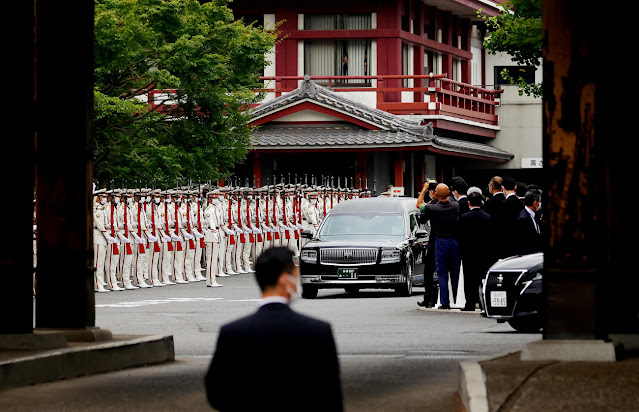 |
The Guard of Honour from SDF attending Abe's Family Funeral on July 12
|
Indeed, on
12 July, at the family funeral of Abe, on the instructions of Kishi Nobuo, then
Defence Minister and Abe’s younger brother, the guard of honour from the Self-Defence
Forces attended the ceremony. The use of the Self-Defence Forces for a private family
matter also seems to be a violation of the Constitution.
Bearing in mind these subversive aspects of state funerals, it becomes clear
that they need to be opposed. Calling for their cancellation is an important
expression of democracy by Japanese citizens. We need to be fully aware of this
fact and expand our opposition to national funerals on a nationwide scale.
Yuki Tanaka


.jpg)


